



U-Shape Sofas UK: The Complete Buying Guide for 2026
There's a reason u-shape sofas keep appearing on every living room mood board right now. That wrapped, generous seating that seems to pull a room together and make it feel genuinely lived-in rather than just furnished. Once you've sat in one, a standard three-seater starts to feel a bit apologetic.
But they're not a purchase to rush. More than any other sofa style, a u-shape rewards doing your homework first. Get the size, layout and fabric right and your living room becomes the room everyone wants to be in. Get it wrong and you'll be edging sideways past your own sofa for years.
Here's everything worth knowing before you buy.
What exactly is a u-shape sofa?
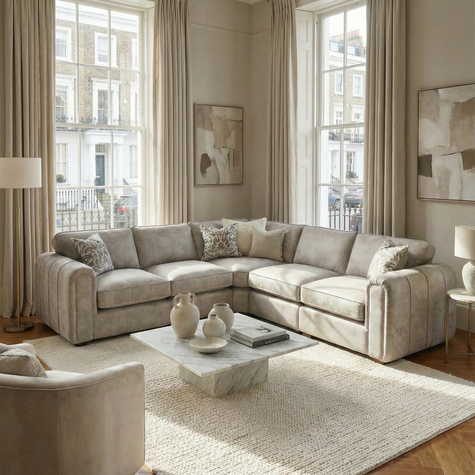
A u-shape sofa, sometimes called a double chaise or horseshoe sofa, is a large sectional piece with seating that wraps around a central space. Rather than one straight run of cushions, it forms three sides of a square, with a coffee table sitting naturally in the middle.
The version most popular in UK homes right now is the double chaise configuration. A central sofa section with a chaise extending from both ends. It gives you the full u-shape feel while keeping the footprint more manageable than a fully symmetrical three-sided design.
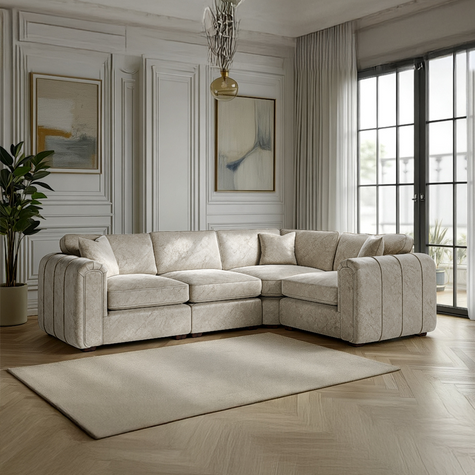
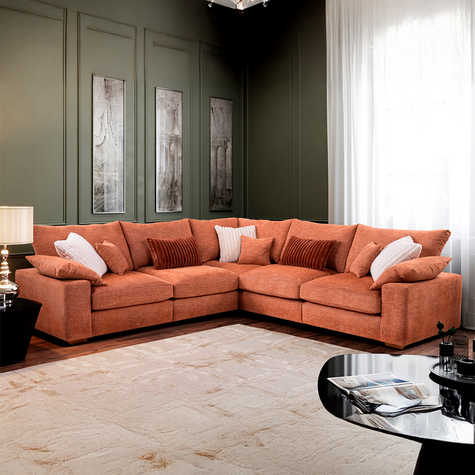
It's worth being clear on how this differs from a corner sofa. A corner, or L-shape, only has two sides. The u-shape adds that third arm, which is what creates the cocooning, inward-facing quality that makes these sofas so good for families and open-plan spaces.
What room size do you actually need?
This is the question most people don't ask until the sofa is halfway through their front door.
The honest answer is that you need a minimum of around 4.5m x 4.5m to fit a standard u-shape comfortably, with enough space left to actually move around the room. That 90cm of clearance around the sofa body isn't a guideline you can fudge. Without it, the room feels like the sofa happened to it rather than the other way around.
In open-plan spaces, u-shape sofas work particularly well. The shape defines the living zone within a larger room without needing walls to do it. The sofa becomes the boundary, which is a much more elegant solution than trying to arrange smaller pieces around a vast floor.
Before you order anything, spend five minutes putting masking tape on the floor in the shape of the sofa you're considering. It sounds low-tech but it's the single most useful thing you can do. Rooms almost always look bigger than they are once you're standing in them measuring.
If your room falls short of that 4.5m ideal, a compact double chaise configuration is worth looking at. Depending on specific dimensions, these can work in rooms closer to 4m x 3.5m and still feel intentional rather than squeezed.
U-shape or corner sofa: which one actually suits your home?
Both are large sectional sofas. The difference is really about how you live in your room.
A corner sofa works well when you want maximum seating along two walls, your room is a more typical UK size, and you want one side of the room to stay open. It's the more practical choice for most standard living rooms and tends to be the safer first sectional.
A u-shape or double chaise is the better call when the room is large enough to justify it and your priority is comfort and sociability over practicality. Everyone faces inward. There's no awkward end seat. Film nights, big family gatherings, lazy Sunday mornings: the sofa handles all of it without anyone drawing the short straw on where they're sitting.
The double chaise also wins outright if stretching out is important to you. Both ends extend into full lounging positions, which means two people can be properly flat at the same time. No standard corner sofa does that.
Choosing the right fabric
Because a u-shape covers a lot of surface area, the fabric question matters more here than on a smaller sofa. You're making a long-term commitment to something that will be very much in the foreground of your room.
Chenille is one of the best performers for daily family use. It's warm, textured and soft in a way that feels genuinely inviting rather than showroom-perfect, and it holds up well to the kind of use a sofa this size will get. The Henry Double Chaise uses a soft textured chenille that hits that balance well, looking good without being precious about it.
Microfibre tends to get underestimated. It cleans easily, resists pilling and feels considerably softer than its practical reputation suggests. If there are children or pets in the house it's genuinely the sensible choice, not a compromise. The Roxy Night XL Double Chaise uses a luxuriously soft microfibre that feels more premium than the price point implies.
On colour: neutrals are the safe long-term play. Cream, oatmeal, oyster and stone all work with changing decor and don't date. But richer shades like sage, mink and chocolate are having a genuine moment in 2026 interiors, and on a u-shape, a confident colour reads as a deliberate design decision rather than a gamble. The key is committing to it rather than hedging.
Styling a u-shape sofa in an open-plan room
Open-plan rooms are where these sofas genuinely earn their reputation. A few principles that make the difference.
Float it away from the wall. A u-shape is designed to sit in the room, not against the edge of it. The open end faces your focal point, the sofa's back defines where the living zone ends. This is what makes the room feel considered rather than just large.
Anchor it with a rug. And make it a big one. It should sit under the sofa and coffee table together, with at least the front legs of every section on the rug. A rug that's too small makes everything float uncomfortably.
Choose a round or square coffee table. A rectangular table fights the shape of the sofa. A round or square one sits naturally in the centre and is reachable from every seat, which is the whole point of the u-shape layout.
Think about lighting. A floor lamp or pendant above the coffee table reinforces the sense of a defined, cosy zone within a larger space. It's a simple thing that makes the seating area feel deliberate.
The Henry XL Double Chaise works particularly well in open-plan rooms. The modular build means you can adjust the configuration to your exact space rather than working around fixed dimensions, and the high back does real work at zoning the room without needing a wall to lean on.
What should you expect to spend?
A well-made u-shape sofa in the UK sits between roughly £1,500 and £2,500 for the kind of quality that will last a decade with normal use. Within that range, what you're actually paying for is construction and cushion quality as much as fabric or brand name.
Reversible cushions are worth prioritising. They wear significantly more evenly and extend the life of the sofa in a way that's genuinely noticeable after a few years. Foam core with a fibre wrap is the standard construction for good reason: it gives you shape retention and the slightly softer, plumper feel that fully foam cushions don't.
Made-to-order sofas, like both the Henry and Roxy Night ranges, tend to deliver a better result than stock pieces. More fabric options, better sizing precision, and a finish that off-the-shelf sofas rarely match. The lead time of 6 to 8 weeks is worth building into your plans, particularly if you're in the middle of a renovation or a move.
Frequently Asked Questions
What is the minimum room size for a u-shape sofa? Most interior designers recommend at least 4.5m x 4.5m for a standard u-shape. You need roughly 90cm of clear walkway around the sofa on all sides. In open-plan spaces, the total room can be larger than this, with the sofa floating in the centre rather than sitting against walls.
Is a u-shape sofa the same as a double chaise sofa? Very similar. A double chaise has a chaise extending from both ends of a central sofa section, creating the same wraparound shape. It's the most popular version in UK homes because it's slightly more compact than a fully symmetrical three-sided design while delivering the same feel.
How many people does a u-shape sofa seat? Most u-shape and double chaise configurations seat between 5 and 7 people comfortably depending on size. The double chaise layout also means two people can lounge fully flat at the same time, which no standard corner sofa can match.
What's the difference between a u-shape and an L-shape corner sofa? An L-shape has seating on two sides. A u-shape has seating on three sides, or a chaise on both ends, which creates the enclosed central space. U-shapes are more social and suit open-plan rooms well. L-shapes are more flexible for standard UK living room sizes and generally easier to fit.
Can you get a u-shape sofa made to measure in the UK? Yes. Bespoke and made-to-measure options are available on many double chaise and u-shape configurations, including through HomeLivingOutlet via in-store or video consultation. Worth considering if your room has awkward features like alcoves, chimney breasts, or a layout that doesn't suit standard sizing.
Ready to find the right fit? Browse the Henry Double Chaise and the Roxy Night XL Double Chaise at HomeLivingOutlet.co.uk. Specialist two-person delivery, room of choice installation, and made-to-measure options all available.