










































A dining bench changes how a table feels. Kids shuffle up to make room for a friend, the room looks less cluttered with fewer chair backs, and on a busy evening there's always space for one more. It's easy to see why so many people add one to a kitchen-diner.
They're not right for every home, though, and the size catches a lot of people out. In this guide we'll help you decide whether a bench suits the way you live, then walk you through length, height, backs, materials and how to pair one with chairs so the whole table looks planned rather than pieced together.
Is a bench right for you?
Be honest about who'll be sitting on it. Benches are brilliant for some households and a bit of a nuisance for others.
A bench works well if…
you've got young children or teenagers who are happy to budge up
one side of your table sits against a wall or under a window
your room is tight and you'd like the seating to disappear under the table
you often need to fit an extra person in at short notice
Chairs might be better if…
older relatives regularly join you, as stepping over a bench isn't easy for everyone
your dinners tend to go on for hours and people like to lean back
whoever's in the middle often needs to get up mid-meal
Plenty of families split the difference with a bench on one side and chairs on the other. We cover that further down.
Measure between the table legs
This is the number that matters most, and it's easy to miss. If you want the bench to slide fully under the table, it has to fit in the gap between the legs (or the frame) on that side. Measure that gap rather than the table top, then look for a bench a few centimetres shorter.

The Barlow set pairs a 1.6m table with a 1.2m Lowen bench, so it slides neatly under the table between the legs.
As a rough guide, a bench around 30–50cm shorter than the table top tucks in nicely on most four-legged tables. People sit a little closer on a bench than on chairs, so allow around 45–50cm per person.
| Table length | Bench length to look for | Seats on the bench |
|---|---|---|
| around 120cm | around 90–100cm | 2 |
| around 135–140cm | around 100–110cm | 2, or 3 children |
| around 160cm | around 115–130cm | 2–3 |
| around 175–180cm | around 130–150cm | 3 |
| around 200cm+ | around 160–180cm | 3–4 |
Buying a bench from the same range as your table takes the maths away. Our Dunmore mango wood tables and benches, for example, come in matching 1.35m, 1.75m and 2m lengths.
Check the height and depth
A bench should sit at roughly the same height as a dining chair: a seat height of around 45–48cm under a standard 75–76cm table. That leaves around 25–30cm between the seat and the table top, which is plenty of room for knees.
Backless benches are usually around 35–45cm deep, so they tuck under easily.
Benches with backs can be 60cm deep or more, so they need more room behind the table.
Adding a cushion to a wooden bench? Allow for the extra few centimetres it adds to the seat height.
Backless or with a back?
This is the biggest style decision, and it comes down to space versus comfort.
Backless benches
They're the classic farmhouse choice. They look light, slide right under the table and you can sit facing either way, which makes them handy as extra seating in the living room too. The downside is that you have to swing your legs over to sit down, and there's nothing to lean on.

The Dunmore 1.75m bench is solid mango wood, with crossed legs that suit a rustic table.
Benches with a back
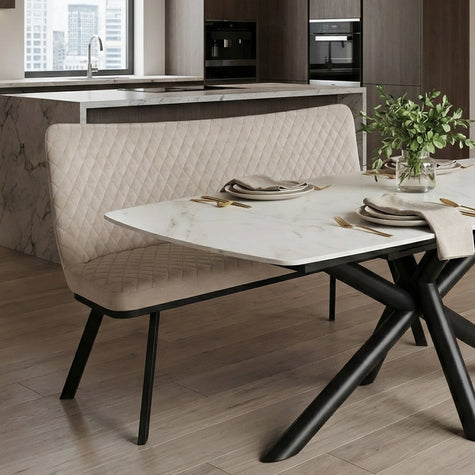
These feel more like a small sofa. They're far comfier for long meals and great along a wall or window, where they almost become a built-in seat. Because they can't tuck under, they work best where nobody needs to walk behind them. Our Tierra velvet bench and Sienna boucle bench both have supportive backrests.
Our tip: if you can't decide, put a backed bench on the wall side and chairs on the open side. You get the comfort and nobody has to climb over anything.
Wood, fabric or leather effect?
Think about who's eating at the table and how much mess they make.
Solid wood: wipes clean in seconds and gets better with age. Add a long seat pad if you'd like a softer sit.
Leather effect: padded and comfortable, and spills wipe straight off. A good all-rounder for families.
Velvet, boucle and other fabrics: the softest and cosiest option, and they bring colour and texture to a plain table. They need a bit more care with food, so choose a darker or mid-tone shade if you've got little ones. Our guide to cleaning velvet has tips for keeping them looking good.
Our Hanson bench is a handy example: the same simple shape comes in light grey or dark grey leather effect, taupe suede effect and grey velvet, so you can match it to your chairs.
Mixing a bench with chairs
A bench on one side and chairs on the other is the classic way to do it, and it looks great when there's a clear link between the two. You don't need them to be identical. Try one of these:
Same material: a leather effect bench with leather effect chairs, even if the shapes differ.
Same colour, different texture: a grey velvet bench with grey fabric chairs.
Same frame: black metal legs on both, or wood that matches the table.

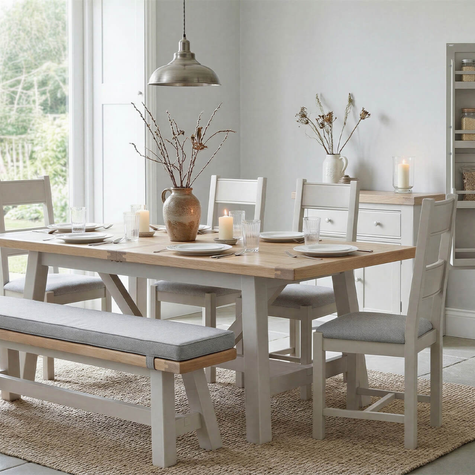
The Henley refectory table with a cushioned bench on one side and chairs on the other: the painted frames tie the two together.
Our Narvik set does the same with grey leather effect on both the bench and the Asher chairs. Chairs at each end of the table finish the look and give anyone who'd rather not use the bench a proper seat. Shop our dining sets for tables that already come with a matching bench and chairs.
Where the bench should go
Put the bench on the side with the least walking room. Because it tucks away, it needs less space behind it than chairs do.
Against a wall: around 60cm between the table edge and the wall is usually enough to step over a backless bench and sit down. Chairs need more like 75–90cm.
Under a window: a backed bench here feels like a cosy window seat. Just check it won't block a radiator.
In an open-plan room: a bench keeps the sightline low across the room, so the dining area doesn't look as busy from the sofa.
Need a new table to go with it? Browse our dining tables, or our guide to dining table sizes will help you check what fits.
Quick bench checklist
Gap between the table legs measured on the bench side
Bench slightly shorter than that gap, if you want it to tuck under
Around 45–50cm of bench per person
Seat height of roughly 45–48cm to match your chairs
Backless for small rooms, backed for comfort against a wall
A material that suits your family and your spills
A colour, material or frame that links the bench and chairs
Common questions
How many people can sit on a dining bench?
Allow around 45–50cm per adult. A 120cm bench seats two adults comfortably, or three children. A bench of around 150cm will usually take three adults.
Are dining benches comfortable?
For everyday meals, yes. Padded or upholstered seats are comfier than bare wood, and a bench with a backrest is the most comfortable for long dinners.
What size bench do I need for a 180cm table?
A bench of around 130–150cm will tuck between the legs of most 180cm tables and seat three. Measure between the legs first, as frames vary.
Can I put a bench at the end of a table?
You can on wider tables, but a short bench of around 90cm at the end of a 90cm-deep table can feel tight. Most people find chairs work better at the ends.
Not sure which bench will fit your table? Send us the table size and our team will point you in the right direction. Get in touch any time.


